Published on Dec. 5, 2025
By La Toya Stevens
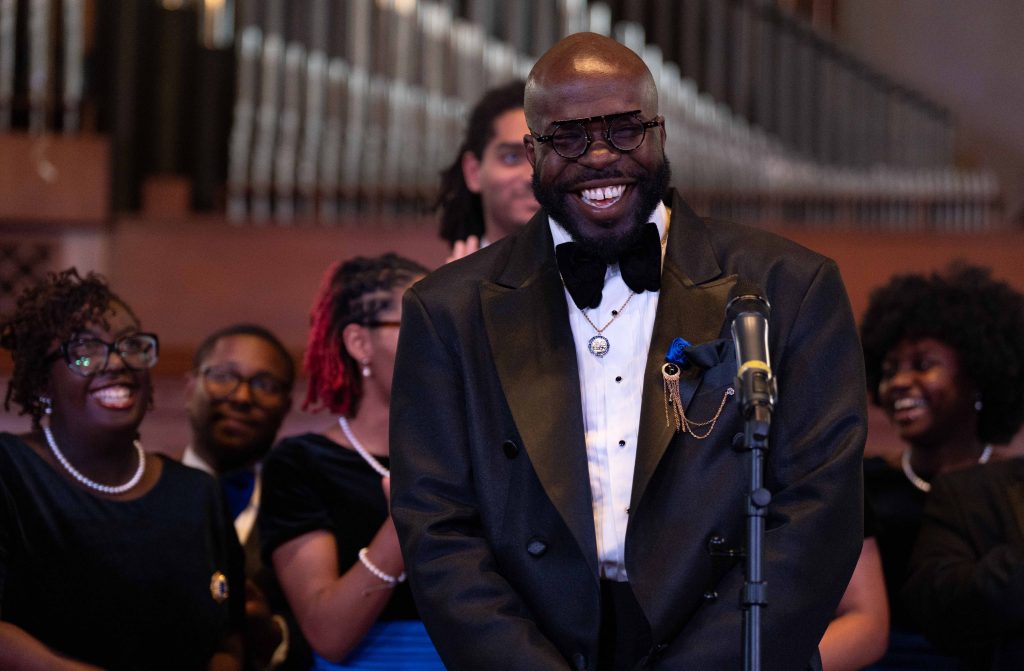
When G. Preston Wilson, Jr. walks into rehearsal now, it’s into a room that carries more than a century of history. As director of the Fisk Jubilee Singers and assistant professor of music at Fisk University, he stands in front of an ensemble whose performance helped save a university, shape American music and share the story of Black freedom with the world.
This is a visible role –– high profile, high stakes and deeply public. But if you take the time to trace back, Wilson will tell you it began in a much smaller room: a reservable study room in a university library, where a graduate writing fellow learned how to listen for a person’s voice long before he ever raised his hands to conduct.
When he returned to graduate school after years in the K-12 classroom, he had to adjust to academic rigor and routines again. The Writing Center –– open to all students, faculty and staff–– became a place where he learned skills that reshaped both his writing and his teaching.
“I thought I was an OK writer,” he says of his early Ph.D. days. “But the Writing Center humbled me –– in a good way. It showed me that even the best writers are still learning, still putting their work in front of other people.”
As the Writing Center approaches its 50th anniversary, that culture of shared learning –– and of writing as a communal practice, not a solitary one –– remains one of its most enduring legacies.
Learning to talk like yourself
Wilson’s introduction to the Writing Center was practical. He needed a job and his advisor recommended he apply there. The interview took place on a day he was directing a concert at a high school where he taught. He remembers using the Wi-Fi at the public library equally concerned if the connection would hold up and at the very idea of him officially helping other people write.
Training arrived with homework. He recalls the discussions on “higher order concerns,” and his shift in mindset. He was not there to simply edit a paper. His role was to find ways to get the person utilizing the service to re-engage with their writing in another format. Soon he was stationed at a small desk in Ellis Library, meeting with anyone who scheduled a session or walked in –– undergraduate students, graduate students, or members of the broader campus community.
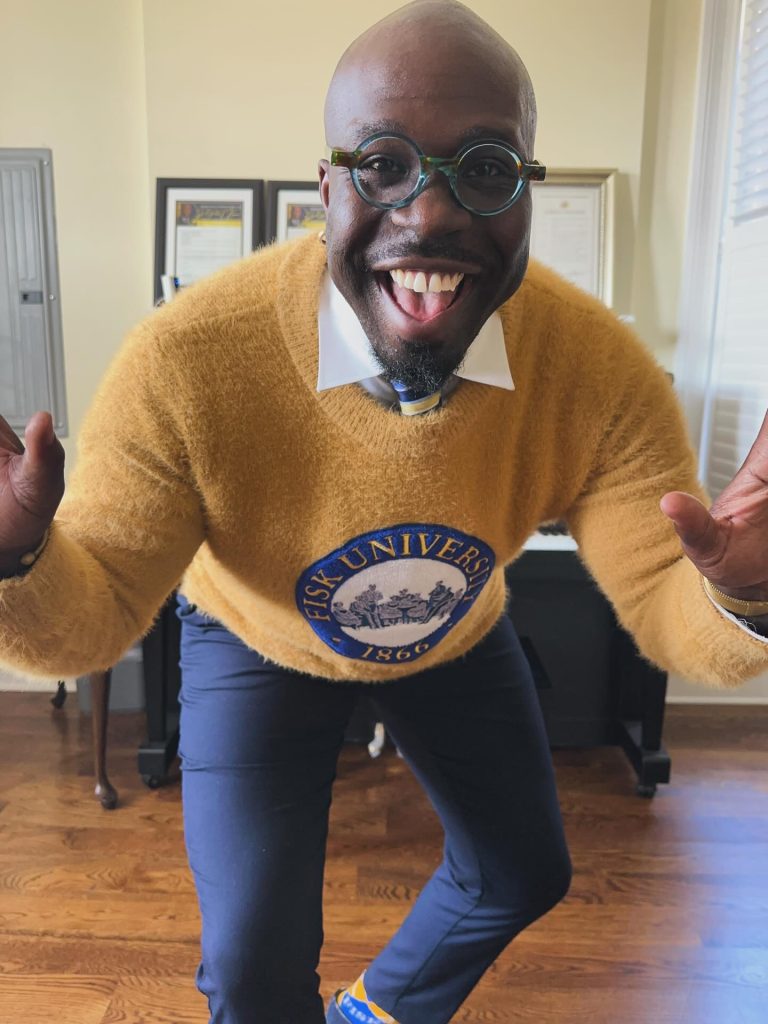
“My first appointment, the student slid the paper over and basically said, “Can you write this for me?” Wilson recalls. “And I had to say, ‘Oh baby, that’s not what we do here.”
What they did next was talk.
He developed his own rhythm asking, “What is this paper about?” and “What are you trying to say?” More often than not, the verbal explanation was far more clear, concise and compelling than what they put on the paper. So, the problem wasn’t that there was a lack of knowledge; they just had not learned how to sound “scholarly.”
“We can get in our own way,” he says. “We think it has to sound a certain way to be ‘academic.’ The Writing Center showed me that the smartest thing you can put on the page is what you honestly think, in the language you actually use.”
That subtle shift –– from fixing sentences to drawing out their voice –– would become the foundation for his own scholarly writing.
A scholar learning in public
The Writing Center would go on to redefine Wilson’s thought process around what it took to be a “good writer.” Sure, he was more comfortable moving between scholarly and accessible prose, and his ability to translate complex ideas in ways that could be understood despite the audience were improving. But what struck him most was watching people he considered experts in their field model intellectual humility.
“Some of the strongest writers I knew –– English majors, people who lived in this world –– still put their work through the Online Writery, still made appointments, still asked for feedback after work,” he says. “Even my advisor, who is an amazing writer, always has at least two people read her drafts.”
This observation shaped the narrative that was forming in his mind about revisions. He understood that requesting feedback wasn’t an indicator of a weak writer; it is in fact, what serious scholars do as a matter of course and for a Ph.D. student learning how to navigate being a student at a large research-intensive institution, that knowledge mattered.
So did community. At the Writing Center he met colleagues who would become close friends, including another tutor from Trinidad and Tobago. They traded appointments, snacks, advice about teaching and jokes about difficult drafts. At times, being a graduate student can feel isolating, but it became less solitary.
“We often do a lot of work by ourselves as Ph.D. students,” he says. “The Writing Center reminded me that community doesn’t just appear –– you go find it. For me, it was in that space.”
From coaching writers to shaping musicians
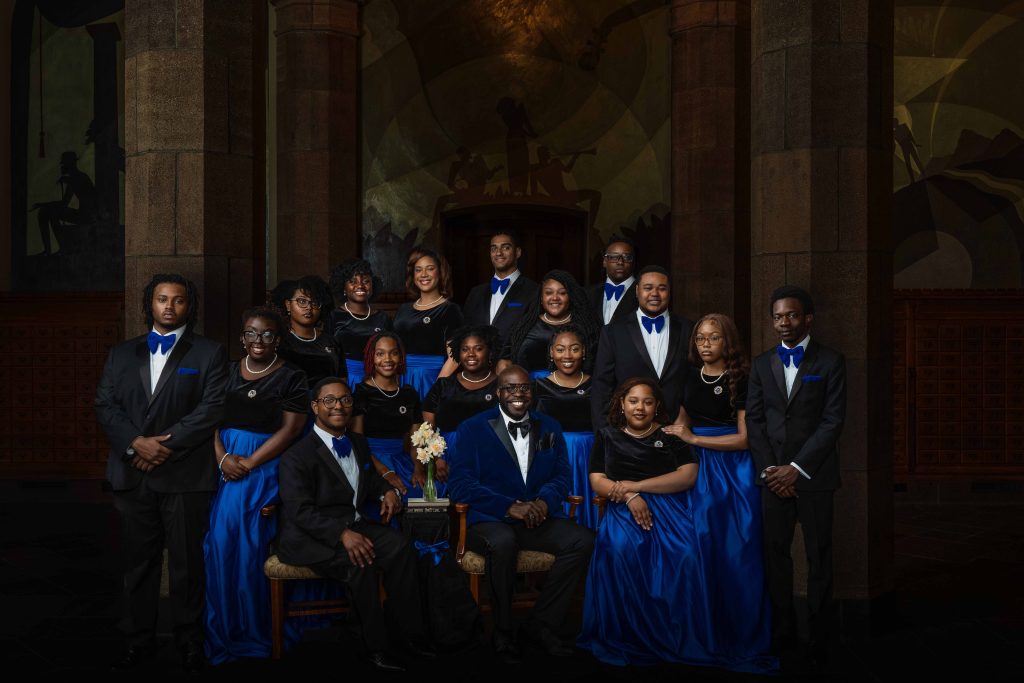
Little did he know, years later, standing in front of the Fisk Jubilee Singers, he would hear echoes of those cubicle conversations in his rehearsal feedback.
At the Writing Center, his job was not to fix a paper but to equip a writer. As a conductor he sees his role in a similar light.
“Sure, I move my arms around from time to time,” he says, “but my real job is to teach independent musicianship. Even if I’m not standing in front of them, they should still be able to make accurate, expressive musical decisions.”
The questions are parallel:
What are the higher order concerns?
What are you really trying to say here –– in this paragraph, in this phrase?
How can I talk less so that you can do more?
Wilson notes that in a writing session, that may mean sticking with the first two paragraphs of a draft until the thesis and organization fall into place and trusting that those insights will continue with the remainder of the piece. On the other hand, in rehearsal it could mean focusing on four measures instead of rushing to get through the entire song, knowing that the breath, balance, diction and dynamics will carry through.
The art and discipline of feedback –– offering it carefully, knowing what to say and when to stop –– also is pertinent to both page and performance.
“As a tutor, I had to be mindful of how much space I was taking up,” he says. “Am I doing all the talking? Or am I giving them opportunities to apply what I’ve said? I think about that constantly now as a conductor.”
Storytelling in Two languages
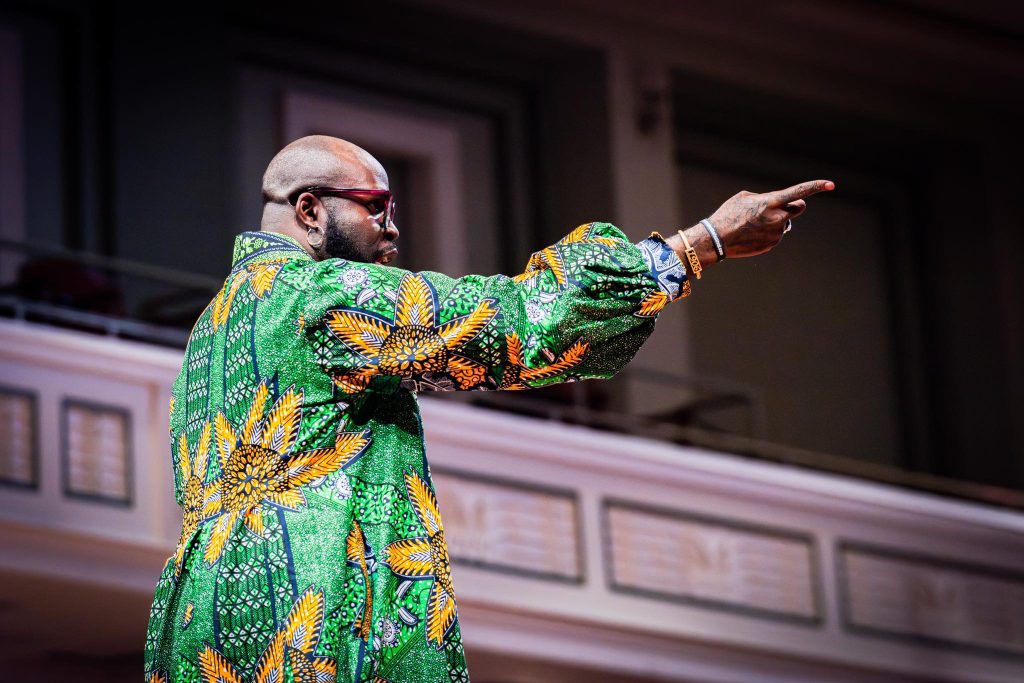
Wilson’s scholarly focus is music education; his daily work is steeped in the Negro spiritual, an art form that braids Western classical structures with the grief, endurance and hope created by African-descended people who were enslaved in the United States. For him, it’s not a stretch to say that writing and music are two dialects of the same language.
“The spirituals are stories,” he says. “Stories of hope, redemption, survival, sometimes humor. When you strip any genre down –– gospel, jazz, R&B, even statistical writing ––you’re still telling a story. You are interpreting what something means.”
It’s that sensibility that guides how he mentors students at Fisk. They come into his offices with more than scores and set lists but also drafts of emails to professors, graduate school essays, even difficult messages to family members. Many of them ask him to look over their words before they send them –– sometimes even before they turn to AI tools.
And he responds with questions he honed as a tutor: What are you feeling? What are you trying to communicate? What are the higher order concerns here? Only after that will they work on phrasing.
Whether it’s on paper or on stage, Wilson is nudging them toward their own voice which is honest and strategic –– one that can navigate institutions without losing itself.
Why Writing Centers still matter at 50
As the Writing Center approaches its 50th Anniversary, Wilson thinks about the impact it has made on the thousands of students who have entered its doors: the first-year student who is learning that a thesis is more than a topic, the international student decoding feedback in a second language, and the future professor quietly practicing the art of giving it.
“Places like the Writing Center are essential because even the best writers need someone to look at their work,” he says. “Sometimes, it’s not about making it ‘better’ as much as it is making it different ––seeing it from another angle.”
He notes that in many industries, people hire strong writers to communicate their ideas to the public. Undergraduates –– particularly first- and second- year students, often arrive believing their high school English habits will carry them through college. Writing Centers help them make the leap to college-level thought and communication.
If he could send a message back to the center that helped shape him ––and forward to the tutors who will guide the next generation –– it would be simple enough to live on an anniversary webpage:
“Thank you for making people better people, one paper at a time.”
For Wilson, the work didn’t end when his shift was over. It followed him as he wrote his dissertation, as he began his first faculty role and into the moment he stepped onto the podium in front of the Fisk Jubilee Singers and felt a quiet sense of relief, that he was exactly where he was supposed to be.
The skills he practiced in that library study room –– listening closely, asking better questions, doing more with less ––are still used every day. But now they happen under stage lights, with spirituals instead of topic sentences and with a room full of students learning, measure-by-measure, to trust the sound of their own voice.
As the Writing Center marks 50 years, we invite alumni, community partners, students, faculty and staff to help strengthen writing support for the next generation. Connect with us, share your story and support the work that has helped thousands of writers find their voice.