Published on April 17, 2026
Updated on July 24, 2026
The University of Missouri’s Writing Center celebrates 50 years of tutoring
By: Cary Littlejohn
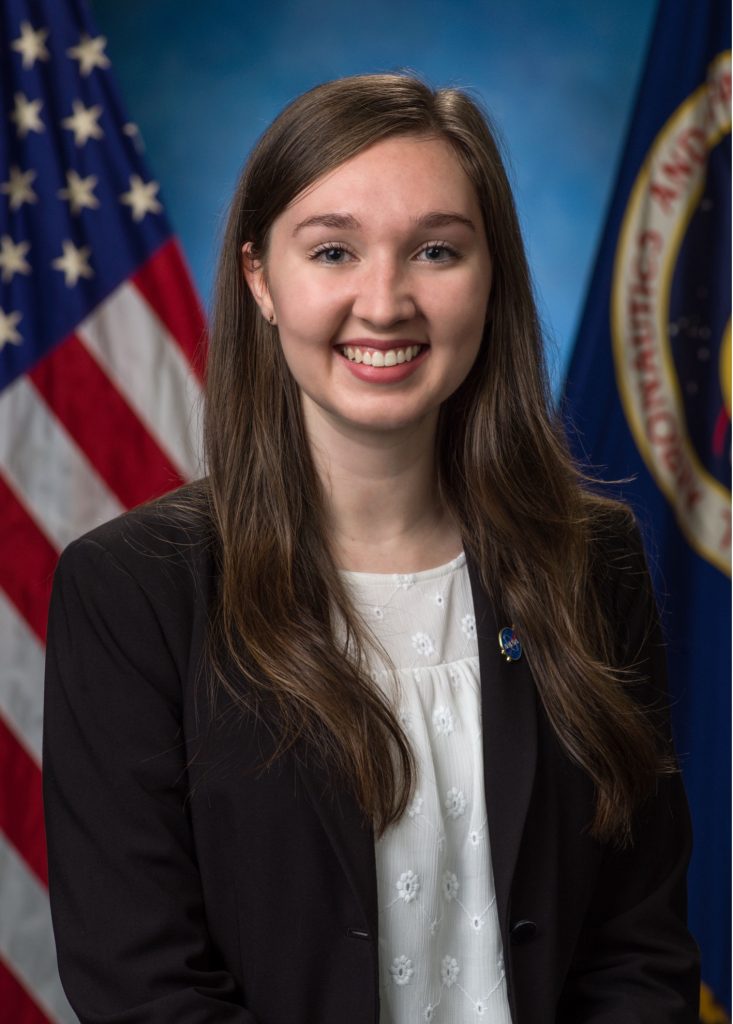
After nearly three years of full-time work, Katherine Herrick, BJ ’19, MLIS ’22, has gotten used to people being impressed by her job.
When she says, “I work for NASA,” oohs and ahhs ensue, eyebrows raise and a predictable chorus follows: “No way! Really?”
Really, she tells the incredulous. For as ubiquitous as the nearly 70-year-old space agency is in the American consciousness, people rarely expect to meet someone who works there.
Herrick works at the Lyndon B. Johnson Space Center in Houston, Texas. It’s one of 10 space centers spread across the country, and though Herrick is of course biased in her assessment, she thinks it’s the coolest one of them all — the one and only Mission Control Center for the U.S. human space flight program.
To state one’s employment is at NASA’s Johnson Space Center is to conjure images of perhaps rocket scientists or astronauts. There certainly are some to be found in the 12,000-plus NASA employees who report to the campus in Houston, but Herrick isn’t counted among their number. Her position keeps her feet firmly planted on Earth, and the tools of her trade aren’t physics calculations or engineering know-how.
Herrick’s position as communications lead in the Office of the Chief Information Officer makes effective use of her unique educational experiences: journalism and informatics and library science. But it’s another experience entirely for which she finds herself most consistently thankful: tutor for the University of Missouri’s Writing Center.
“I cannot tell you how many times since I started my job that I’ve thought, ‘Wow, I’m so glad I worked at the Writing Center,’” Herrick said.
The Writing Center has been a powerful presence on Mizzou’s campus for 50 years now, and its ranks are filled with alumni who credit the lessons learned and skills honed through tutoring among the most valuable of their education.
Herrick’s appreciation for her education was never stronger than the month she spent revisiting her Writing Center roots to help an uncomfortable crew of infrequent writers: NASA pilots.
Once a tutor, always a tutor
Science is everywhere at NASA, and as a result, perhaps one does not think of writing when imagining the behind-the-scenes work in Houston. All spaceflight — but especially human-crewed spaceflight of the type prioritized at Johnson Space Center — is a modern marvel of mathematics, physics and engineering, so it would not be surprising if minds turned to figures and calculations instead of the sentences and paragraphs.
But NASA faces the same fundamental challenge that Mizzou undergraduate and graduate students from STEM disciplines face every single day: how to transform scientific findings into coherent storytelling. No matter how exacting and rigorous the experiments or how voluminous the empirical data, writing will always be necessary to communicate those results to the widest possible audience.
The Writing Center trains its tutors to help with those challenges — and any others that writers might face at any stage of the writing process, from brainstorming to final draft.
When an opportunity arose in May 2025, Herrick found herself, without hesitation, resuming an old, familiar position.
“I was asked to assist a group of pilots on a research project,” Herrick said. “They’re people who love to be outside and flying and not necessarily inside and writing papers. It was a really long paper — 100 pages or more — and for six to eight hours a day, I basically was their tutor.”
She provided high-level writing expertise that her pilot colleagues greatly needed.
The pilots made requests she knew well: make sure the paper is well organized, that it makes sense to a general audience. They were going to have to do a presentation on it, Herrick said. They needed help with formatting and using Microsoft Word. From the big-picture to the task-specific details, she did not encounter anything for which the Writing Center hadn’t already prepared her hundreds of times over.
It fell to Herrick to sit in on the pilots’ conversations and synthesize what they were talking about and how it needed to be included in the report. Despite lacking any subject-matter knowledge on the topic of the report, Herrick used the same skills that have been taught to Writing Center tutors for five decades.
What stood out was how prepared she felt for the moment. When her boss told her about the difficulties surrounding such an undertaking — long days, how easy it was to lose steam as writers — she nodded along knowingly, but she did not feel as worn down by the long days as the pilots did.
“I felt like I was conditioned for this,” Herrick said. “I felt like I just did five sessions back to back during finals week.I was the one who could keep things moving, and I was just so glad that I had that practice in the past.”
Skills to last a lifetime
Herrick’s tasks don’t always rise to the level of writing research projects with the pilots, but she still feels the value in her Writing Center experience paying off daily.
“Honestly, any time someone sends me something that’s IT-related and I end up calling them to talk about what they’re trying to say, I feel like so much of what I do is take people back to ‘What is the assignment? What are we trying to communicate? What do you need people to do?’” Herrick said. “I’m often bringing things back to their thesis statement.”
These foundational questions represent critical thinking skills that were developed in both the student writers and, sometimes to an even greater degree, the tutors.
She was helping the student by providing thoughtful and actionable insights on their writing, but Herrick was growing as well — as a writer, as a communicator, as a leader.
Her experience mirrors those of so many tutors who’ve passed through the Writing Center over the past 50 years, and like so many alumni of the Writing Center, she can also point to the ways in which the Writing Center has shaped her as a person.
“I don’t think I’d be where I am today without the Writing Center,” Herrick said.